Yfirlit fyrir hluteigendur
Hermes tekið upp sem sjálfstætt research runtime · xAI Developer reikningur opnaður fyrir tweet analysis.
Yfirlit
Hermes (Nous Research, MIT, open-source) becomes the runtime that powers Visk-AI's autonomous research loop. xAI's developer API gives that same loop legal, programmatic access to Grok for tweet analysis from Slack.
§1
Hvers vegna ramminn vinnur á eigin verðleikum, og fimm skilyrði sem fylgja.
Two paths: hand-roll a minimal agent loop on Railway (4–8 months to parity) or adopt Hermes, Nous Research's open-source agentic framework. We adopt — hand-roll stays as fallback if any of five conditions fails.
| Axis | Why it matters | Hermes today |
|---|---|---|
| Code quality | A framework we can't patch fast becomes a liability. | 166,420 stars · 4,802 merged PRs · 165k LoC in last 9 days. |
| Release discipline | Trading-adjacent code needs auditable releases. | Weekly tagged releases (vYYYY.M.D) · public release notes. |
| License | Clean IP posture for client deployments. | MIT verbatim · no CLA friction. |
| Security posture | The framework's threat model must match ours. | Explicit "OS is the only boundary" doctrine. |
| Supply chain | One bad dependency wipes a quarter of work. | Exact-pinned deps · documented quarantine response to the 2026-05-12 mistralai Mini Shai-Hulud incident. |
| Plugin surface | Our security controls live as plugins. | 17 of 23 hardening requirements implementable as Hermes plugins, configs, or built-ins. |
| Community velocity | Bus-factor risk mitigated by inbound contributors. | 215–295 community contributors per release cycle. |
Composite maturity score
3.2 / 5 — adopt with conditions.
If any fail, we revert to hand-roll.
Deploy v2026.5.16 (Hermes v0.14.0). No auto-pull.
Hardened Docker Compose stage 1. NVIDIA OpenShell stage 2.
No third-party marketplace. Egress-blocked at the network layer.
Pantheon-controlled copy. Upstream disappearance does not strand us.
Budget plugin maintenance into operating cost — framework moves fast.
Hermes is a framework, not a finished platform. Four things we add ourselves:
| What's missing | How we fill it |
|---|---|
| Dual-LLM separation | We add it as a plugin · 1–2 days |
| Database access boundary | Supabase provides it (Row-Level Security) |
| Network egress firewall | Envoy sidecar in the same Railway project — single highest-value control |
| Trading-grade audit trail | Separate Supabase project · append-only log |
§2
Hvernig útfærslan er löguð — og ákvörðunin sem afmarkar áhrifin.
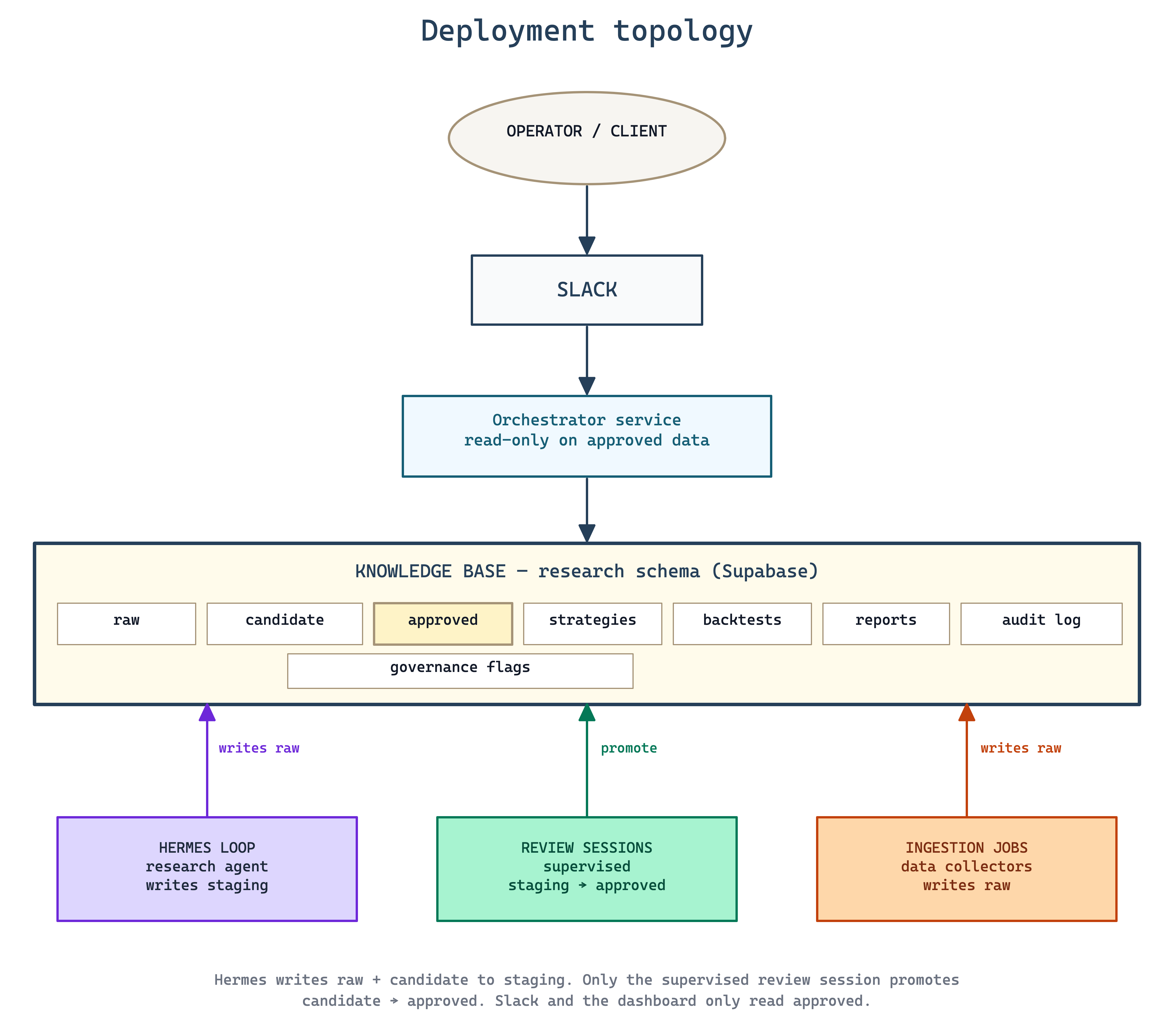
Hermes does research and writes into a staging area. A separate supervised review process is the only path that promotes work to approved. Slack and the dashboard only read from approved. The research engine cannot bypass review.
Tier 1 · Hermes working memory. Inside the Hermes container. Transient reasoning state. Local SQLite-backed with trust scoring. If lost, rehydrates from staging.
Tier 2 · Synthesized research wiki. Separate service. Holds the curated client research. Hermes has no read access — writes raw to staging, separate synthesis promotes. Container compromise does not exfiltrate the wiki.
Lag 1 + sviðsetning fara í áfanga 1. Samsetningarþjónusta í áfanga 1.5. Rekstraraðili valdi þetta með orðunum „we can afford to take the time to ship this properly."
| Runtime | Railway CPU containers · Pro tier. |
| GPU | None. Railway does not offer GPU instances. All inference via API. |
| Primary inference | Nous Forge API (inference-api.nousresearch.com) · Hermes-4 family · OpenAI-compatible. |
| Non-Nous models | OpenRouter · zero-retention filter · provider failover · model pinning. |
Read raw market + thematic signals. Core research loop.
Write to staging tables. Designed boundary.
Write to approved tables. Only the review process can promote.
Read the curated wiki. Bounded blast radius (Tier 2).
Hold broker credentials. Stage 2 question · separately gated.
Execute trades. Stage 2 question · separately gated.
Reach the open internet. Envoy egress sidecar · default-deny allowlist.
§3
Af hverju Developer API en ekki SuperGrok — og hvar reikningurinn liggur í verkflæði.
The xAI Developer API (api.x.ai) is the only Grok surface that legally permits programmatic access. Every consumer Grok variant is forbidden by xAI's terms for bot use.
| Variant | Has API? | Use for bots? |
|---|---|---|
| SuperGrok consumer ($30/mo) | No | Forbidden |
| SuperGrok Heavy ($300/mo) | No | Forbidden |
| X Premium+ (includes Grok) | No | Forbidden |
| Grok Business ($30/seat) | No | Forbidden |
xAI Developer API (api.x.ai) | Yes | This is the path |
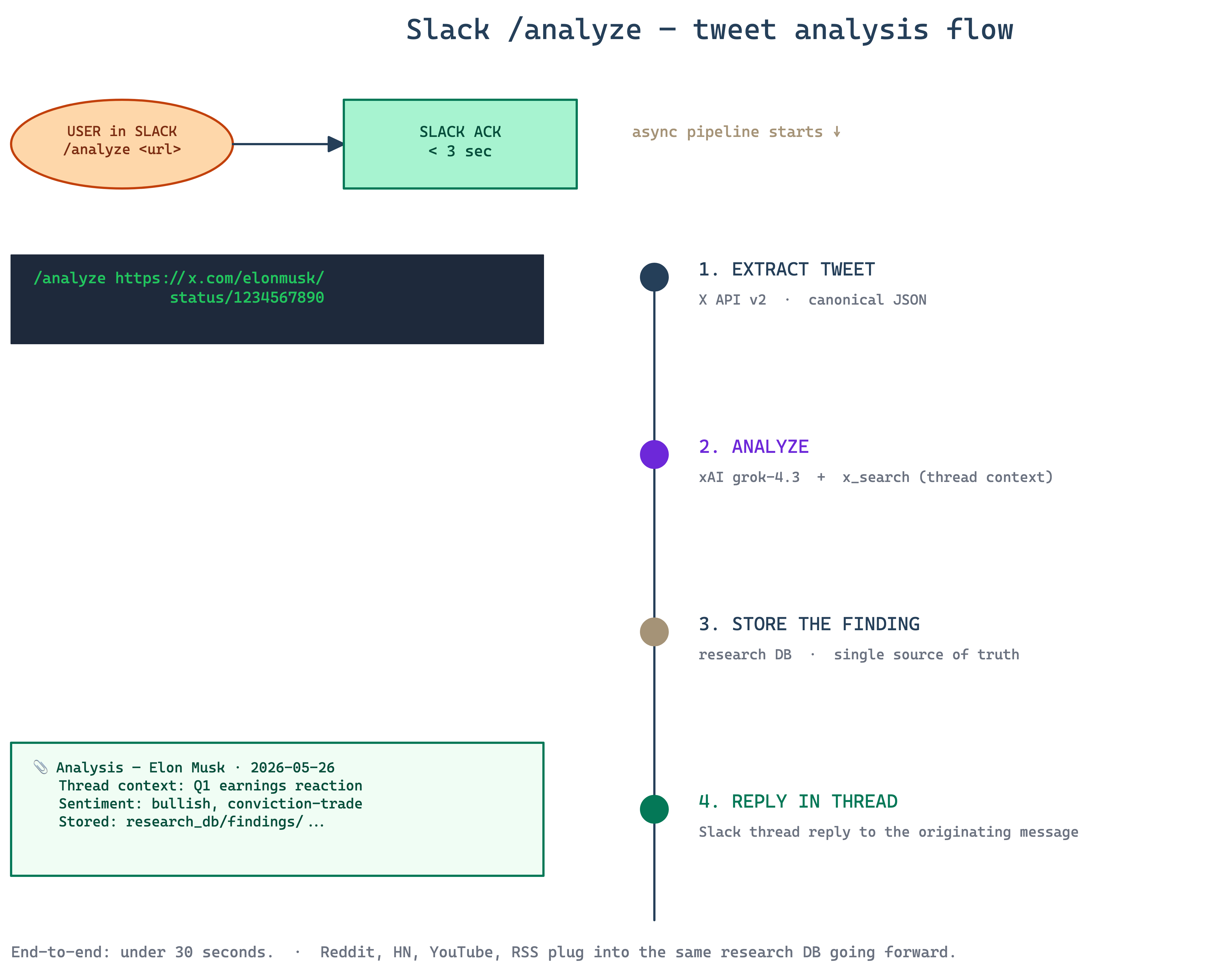
grok-4.3 — smartest current Grok. Analysis quality.grok-4-fast — cheaper variant. Cost optimization once volume is known.x_search tool — Grok-side built-in that fetches thread + quote context without a separate X Developer account. Killer feature for tweet analysis./analyze
Same Grok account is the analysis engine; same research database is long-term memory. Reddit, HN, YouTube, RSS plug into the same table going forward.
§4
Verðlagning á verkefni í tveimur sviðsmyndum. Light = Stage 1 grunnlína. Heavy = market-hours hot.
/analyze tweet analysis| Component | Per call | 10 / day | 100 / day | 1000 / day |
|---|---|---|---|---|
| Tweet extraction (X API v2) | $0.005 – $0.025 | $1.50 – $7.50 | $15 – $80 | $150 – $800 |
Analysis (xAI grok-4.3 + x_search) | ~$0.011 | ~$3 | ~$33 | ~$330 |
| Slack delivery | $0 | $0 | $0 | $0 |
| Storage (free tier) | $0 | $0 | $0 | $0 |
| Subtotal | ~$0.016 – $0.036 | ~$5 – $11 | ~$50 – $115 | ~$480 – $1,130 |
Volume gate
$200/month soft cap. Crossing it pages the operator via a daily-cost probe.
| Volume | Token budget | Monthly cost |
|---|---|---|
| Light (stage-1 baseline) | 5M tokens / day | ~$23 |
| Heavy (multi-room or market-hot) | 50M tokens / day | ~$230 |
Nous rate-limit tier: Default (180 req/min) at launch. Ultra only when telemetry justifies. Every request instrumented from day one.
| Volume | Cadence | Monthly cost |
|---|---|---|
| Light (event-driven, off-hours) | On artifact-ready signal | $50 – $150 |
| Heavy (market-hours, 1–2 min cadence) | Continuous | $300 – $800 |
OpenRouter's 5.5% aggregation fee buys: single credential surface, per-request zero-retention filter, automatic provider failover, model-ID pinning that catches silent vendor swaps.
| Volume | Token budget | Monthly cost |
|---|---|---|
| Light | 0.5M tokens / day | ~$10 |
| Heavy | 4M tokens / day | ~$80 |
Finance-tuned, 1024-dim, cheapest in tier. Column dim pinned to 1024 → swap to self-hosted bge-large-en-v1.5 later without schema migration. OpenAI text-embedding-3-small held as DR fallback (1536-dim → re-embed required).
| Line | Light volume | Heavy volume |
|---|---|---|
| Nous Forge (Hermes-4) | $23 | $230 |
| OpenRouter (non-Nous mix) | $50 – $150 | $300 – $800 |
| Review session tokens | $50 – $100 | $150 – $300 |
| Railway runtime (+ Envoy) | $50 – $80 | $80 – $150 |
| Embeddings (Voyage-3-lite) | $10 | $80 |
| Database (existing) | $0 | $25 |
| Stage-1 total | $183 – $363 / mo | $865 – $1,585 / mo |
Tweet analysis adds $50 – $115 / mo at 100 analyses/day on top.
Stage 2 (out of scope here)
If/when we move to broker execution, the floor jumps roughly $1,500 – $2,500 / mo before execution cost. Separate decision arc.
§5
Staðfesting við hvert skref áður en næsta hefst.
research schema, Row-Level Security forced on every table.Tweet-analysis Slack workflow lands as a parallel sub-arc — five active phases · ~3.5 person-days · ready when step 1 credentials land.
§6
Frestaðar ákvarðanir sem viðskiptavinurinn ætti að vita af — ekki óvissa.
Operating on working assumption of "no EU-residency requirement" pending legal confirmation. Architecture built so reversal is a configuration change, not a rebuild.
Default routing for review prompts is OpenRouter with ZDR filter. Direct Anthropic ZDR is a separate contractual upgrade — confirmed before any prompt carries client-identifying tokens.
Voyage-3-lite is the launch pick. Documented swap path to a self-hosted alternative that does not require corpus re-embed. Triggered by cost pressure or data-sovereignty needs.
Stage 2 work. Will not begin until stage 1 is stable and the review process has accumulated 30 days of operator-comparison data.